

The good kind of AI made in Vienna
17.11.2026
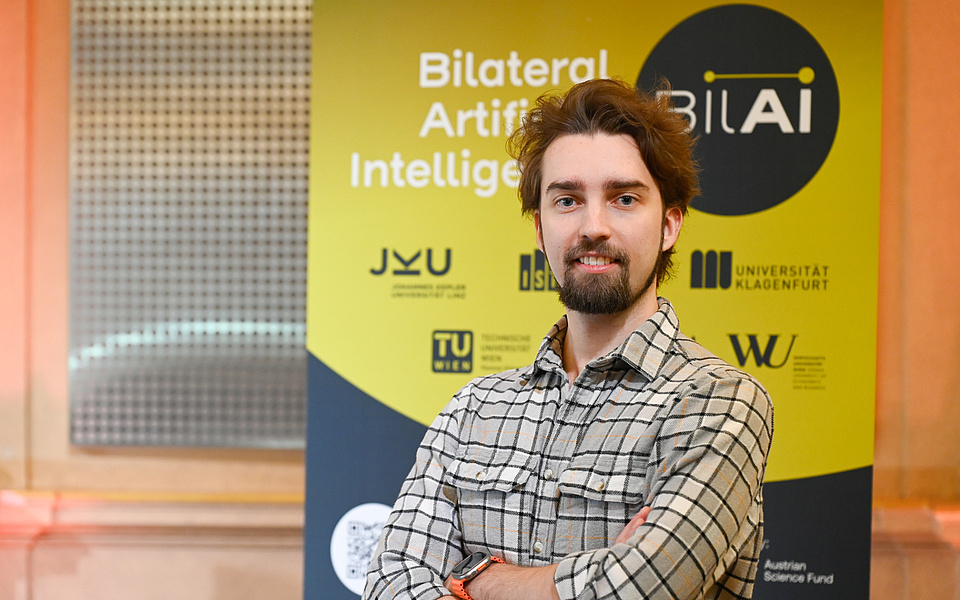
Nomen est omen: BilAI PhD researcher Daniel Dobriy is growing his recently founded spin-out Dobriy AI. Three core technologies based on knowledge graphs and neuro-symbolic AI provide a European alternative to Big Tech.
In 2001, Tim Berners-Lee, the inventor of the Web, and his colleagues, James Hendler, and Ora Lassila, imagined intelligent agents that could navigate the Web of Data and carry out tasks on users’ behalf [1]. The years that followed produced extensive research aligned with that vision: organising knowledge, reasoning over it and creating the Web infrastructure to make such data agents possible.
Fast forward to spring 2026, when BilAI doctoral researcher Daniel Dobriy founded his spin-out Dobriy AI, which translates from Ukrainian as “the good AI”. He aims to turn the vision of trustworthy intelligent agents into reality. “It has always been my goal to convert research results into market-ready technologies”, Dobriy explains his motivation.
The impetus emerged from the research environment at the Institute for Data, Process and Knowledge Management at the Vienna University of Economics and Business (WU). There, Dobriy met his PhD supervisor and BilAI key researcher Axel Polleres.
Less hallucination through neuro-symbolic AI
In its first six months, Dobriy AI has already made significant progress. With a growing team of currently ten members based at the AI Factory Austria, Dobriy AI is developing three core technologies: the “symbolic” language model family Eunou (pronounced “you know”), an infinitely scalable knowledge graph host as well as a European search engine based on data.
“Bilateral AI enables search that does not guess, gives exact and full answers, and rewards content creators – who have made the revolution in AI possible”, emphasises Managing Director Dobriy. His vision is to create a more ethical, equitable and sustainable approach to AI than that of Big Tech companies.
Unlike the dominant language models trained on natural language, Dobriy AI’s “symbolic” models learn from knowledge graphs. Based on meaning representations and unique identifiers for concepts, such models work with semantics directly, are multilingual by design and can handle data efficiently. This results in a less biased, more equal performance in dominant and under-represented natural languages alike, and makes it possible to validate model outputs logically.
A European solution under way
To develop its technologies further and put ideas into practice, Dobriy AI partners with various public institutions. Besides participating in the Austrian Federal Chancellery’s Public AI Hackathon, Dobriy AI collaborates in the areas of large-scale market intelligence, education, cultural heritage, research infrastructure and participative democracy tooling.
The focus rests on strategic private-sector collaborations, according to the founder of Dobriy AI, who is also leading the Austrian Chapter of the Open Knowledge Foundation, advocating for publishing open knowledge serving the public good.
For the near future, Daniel Dobriy has ambitious plans to expand his AI research and venture studio and gain market share. The goal is to make all three core technologies a staple of the Web and AI infrastructure by the end of 2027.
One concrete example is the BilAI Knowledge Graph, a resource for the BilAI research community, which is built on knowledge graphs, web-scale data and neuro-symbolic AI to disseminate project results. This architecture makes research, tools and resources easy to discover for humans and AI agents. It is hosted and operated by the spin-out and grows through the active contribution and participation of researchers.
Dobriy invites anyone interested in building a better AI to get in touch: “Do reach out as an organisation, but also sign up as a developer to build with the technologies and platforms we create. And if you’re interested in disrupting AI and the Web for the better, send us your CV.”
Sign up for Dobriy AI’s newsletter and get the latest updates.
[1] Berners-Lee, Tim, James Hendler, and Ora Lassila. “The Semantic Web.” Scientific American 284, no. 5 (May 2001): 34–43.


