
BilAI at the Public AI Hackathon: Turning legal text into transparent machine-readable logic
13.05.2026
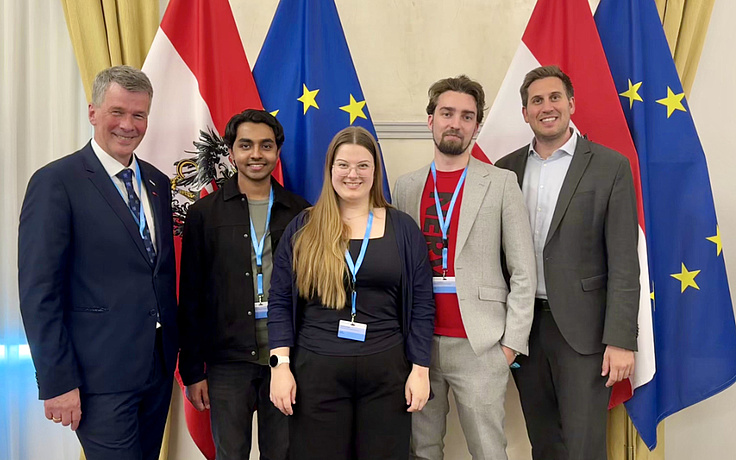
The Public AI Hackathon, powered by TU Austria and the Austrian Federal Chancellery (BKA), brought together a selected group of researchers and practitioners to address key challenges in AI for public administration.
From more than 200 applicants, only 25 participants were selected, forming focused teams to tackle real-world problems in digital government transformation. Among them were BilAI PhD researchers Veronika Semmelrock (University of Klagenfurt), Daniel Dobriy, and Vishal Nair (WU Wien), who collaborated on the Law-to-Code challenge: translating human-readable legal grant requirements into strict, machine-executable logic.
The challenge focused on making eligibility criteria in public grants explicit, transparent, and auditable—moving away from opaque, black-box decision systems. This aligns closely with BilAI’s core vision of developing trustworthy neurosymbolic systems for regulatory domains.
Approach and Technical Contributions
The team developed a modular system combining complementary technical components:
- an LLM-based translation pipeline, evaluation framework, and visualization UI to support end-to-end transformation and inspection of outputs.
- a formal grammar and constrained generation layer to enforce syntactic validity and rule-consistent representations.
- LLM orchestration with dynamic prompting, feedback loops, and constrained decoding strategies to improve robustness and consistency across iterations.
Together, these components enabled the structured conversion of legal text into machine-executable rules while maintaining interpretability and user control.
Key Insight
A central takeaway from the hackathon was that neither machine learning nor symbolic methods alone are sufficient for real-world regulatory systems. Legal and administrative domains require:
- deterministic behavior
- transparency by design
- full interpretability and auditability
- humans remaining in control
This makes neurosymbolic approaches particularly relevant.
The BilAI team developed a hybrid workflow with humans in the loop, where AI supports the identification and structuring of legal rules, and domain experts validate and integrate them into a formal model.
The approach was then applied to the Austrian grant ecosystem, enabling structured modelling of grant requirements as a basis for future personalised and rule-based recommendation systems for citizens and companies.
Check out the news article from Digital Austria for further information about the Public AI Hackathon and its outcomes. (Article in German)