

To ban or not to ban AI in higher education?
29.10.2026
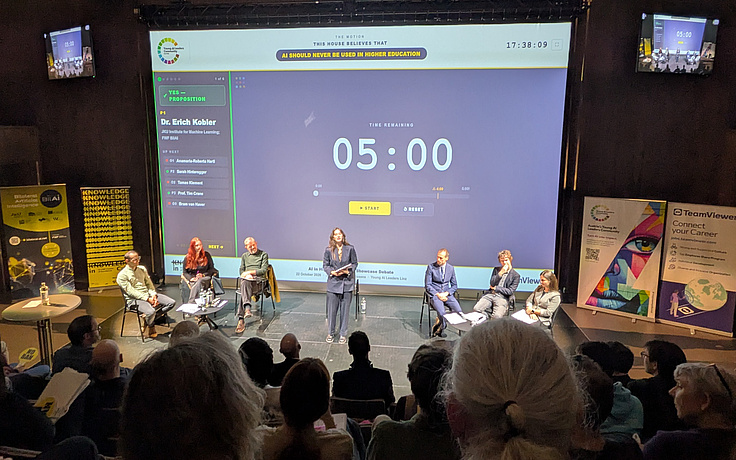
In an Oxford-style debate in Linz, BilAI members Erich Kobler and Anamaria-Roberta Hartl took opposing sides on a potential ban of AI in higher education. The audience verdict was unambiguous.
In the pursuit of efficiency, it is tempting to use AI to complete assignments and to write and grade academic papers. Should universities adapt to this development or, on the contrary, should AI be banned from higher education altogether? Researchers, students and policymakers from different disciplines came together to discuss this highly topical issue at the Zirkus des Wissens on the campus of Johannes Kepler University Linz (JKU).
BilAI members Erich Kobler and Anamaria-Roberta Hartl, Assistant Professor and PhD student at JKU’s Institute for Machine Learning, respectively, are usually on the same team. However, on Thursday night, they found themselves on opposing sides. Kobler supported the ban together with two speakers from Central European University (CEU) – Tim Crane, Professor of Philosophy and Research Director at Knowledge in Crisis, and philosophy student Sarah Hinteregger. Opposing them were Hartl, Tamas Klement, a Data Science and Society student at CEU, and Bram van Haver, Lead Project Officer at UNESCO’s Youth for Peace initiative.
The pros and cons of AI in higher education
Each speaker had five minutes to argue their assigned side of the motion: “This House believes that AI should never be used within higher education.” Both the proposition and the opposition voiced concerns about the risks of AI in higher education and showed a surprising degree of common ground. Their views on a total ban, however, diverged considerably. For example, both sides recognised curiosity as an essential element of the learning process and highlighted the risk that AI could diminish its value.
“If you outsource the struggles, you also outsource the education”, Kobler warned against the use of AI. He also reminded the audience that degrees constitute a promise to society that graduates can carry out certain tasks. Hartl, opposing the ban, suggested grading the process rather than the outcome: “The future doesn’t need a university that is kept away from AI, it needs a university that understands it better than anyone.”
Van Haver, too, urged universities to prepare students for a world in which AI plays a significant role: “A human-centred and evidence-based approach is more demanding than a ban but it is also more consistent with the responsibilities of higher education.” He also predicted that the introduction of a ban would not prevent the further development of AI outside of universities. Enforcement would also be hampered by the lack of reliable AI detectors, Klement pointed out.
The proposition countered by pointing to the practical implications of unrestricted AI use in the humanities and social sciences. Using AI tools to summarise readings endangers the very essence of these disciplines, Crane argued: “Reading is the process of understanding the ideas themselves. Without reading, there is no understanding and without understanding, there is no education.”
“The motion falls”
Despite Hinteregger’s warning that universities could become “ghost towns” if AI continues to be used by students and staff, the audience was not convinced by the arguments of the proposition. The vast majority of listeners voted against the ban. “The motion falls”, moderator Sophia Marinov from Young AI Leaders Austria announced, before opening the floor to questions from the audience.
The event was initiated by Young AI Leaders Linz and co-hosted by the FWF Cluster of Excellence Knowledge in Crisis, in cooperation with BilAI and Toastmasters Linz.


