

From a summer school idea to an ESWC paper: Teaching AI to “repair” Wikidata
19.03.2026
How a group project at the International Bilateral AI PhD Summer School 2025 evolved into full research on collaborative knowledge graphs.
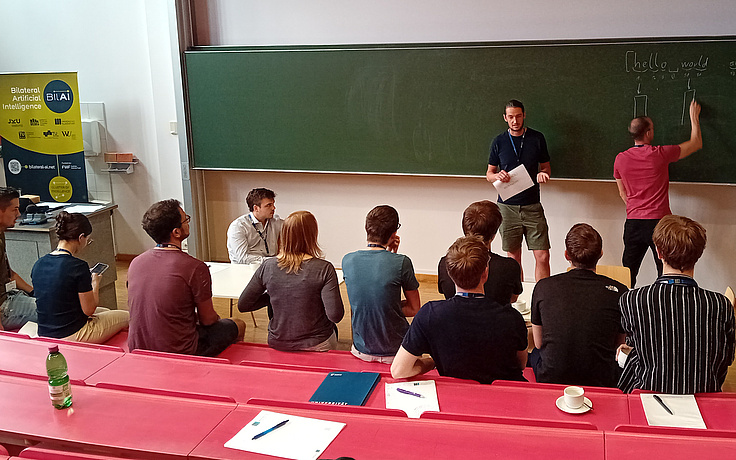
At the first International BilAI PhD Summer School 2025 in Klagenfurt, one of the most productive — and ultimately most far-reaching — moments emerged from a simple yet powerful question raised during group work:
“If humans constantly fix mistakes in Wikidata, can we train a model to learn from those fixes and suggest good repairs automatically?”
This single question set the direction for a research effort that has since developed into a full scientific contribution. The work, led by PhD student Miguel Vazquez together with collaborators from across the Bilateral AI network, has been accepted as a full paper at the 23rd European Semantic Web Conference 2026 (ESWC) with the title: “Structure is the Signal: Graph Encodings and GNNs for Constraint Repair in Collaborative Knowledge Graphs” by Miguel Vázquez, Kevin Innerebner, Alexander Prock, Günter Klambauer, Elisabeth Lex, Johannes Schimunek and Axel Polleres.
Origins at the BilAI Summer School
Within a project group led by BilAI key researcher Axel Polleres and Johannes Schimunek, Postdoc Researcher at JKU Linz, the focus was on neuro-symbolic approaches for large, real-world Knowledge Graphs. These systems require combining structured, symbolic validation with machine learning methods that can adapt to complex and evolving data.
The central idea developed within the group around PhD student Miguel Vazquez was straightforward: instead of relying only on manually defined repair rules, models should learn how to fix errors by observing how humans have done so in practice.
Using Wikidata as a case study, the team explored how Graph Neural Networks (GNNs) could be trained on historical edit patterns. By analyzing “before-and-after” states of the data, the model learns to predict edits — such as adding, deleting, or modifying statements — that transform invalid graph fragments into valid ones.
A key insight quickly became central to the project: For this task, structure is not a detail — it is the signal.
Constraint violations in Knowledge Graphs often have recognizable patterns in the local neighbourhood around the problematic statement, and capturing this structure is essential for effective repair.
From Prototype to Research Collaboration
While the idea originated during a one-week group project, the work continued well beyond the BilAI Summer School. The format provided the necessary foundation to carry the idea forward.
Three elements during the Summer School made it possible to continue the project afterwards:
- a working proof of concept demonstrating feasibility and research potential
- a clear research plan, covering data extraction, subgraph construction, model design, and evaluation - and
- a collaboration bridge across institutions within the Bilateral AI network.
In the months that followed, the initial prototype evolved into a sustained cross-institutional effort involving partners from WU Wien, TU Graz, and JKU Linz. This collaboration ultimately led to the accepted ESWC 2026 paper.
Research Approach and Objectives
At its core, the project can be understood as a form of “spell-checking” for structured databases like Wikidata.
- Constraints act as grammar rules (e.g., “only one value” or “required companion statements”)
- Violations are analogous to errors
- Repairs correspond to corrections — removing incorrect data, adding missing information, or resolving inconsistencies.
While symbolic systems can reliably detect many violations, proposing suitable repairs is more complex. There may be multiple valid fixes, and the best one depends strongly on context.
The proposed approach represents each violation as a local subgraph and uses a Graph Neural Network to suggest edits. Importantly, the system does not only imitate historical human edits — it also verifies whether the proposed repair actually resolves the constraint violation.
A BilAI success story
"This paper is a direct example of what BilAI is designed to enable: collaboration where symbolic validation and sub-symbolic learning reinforce each other, accelerated by an environment that makes it easy to go from an early idea to a concrete research artifact. Turning a one-week group project into an ESWC paper took months of work, but the starting point mattered."
Miguel Vazquez, BilAI PhD student from WU Wien
The registration for the Bilateral AI PhD Summer School 2026 is now open and will take place as part of ESSAI26.
For more information about the programme and for registration go to the official ESSAI 2026 website.