

Bilateral AI at the StartUp InspirAItion Day: real founding stories, practical insights and conversations that matter
26.05.2026
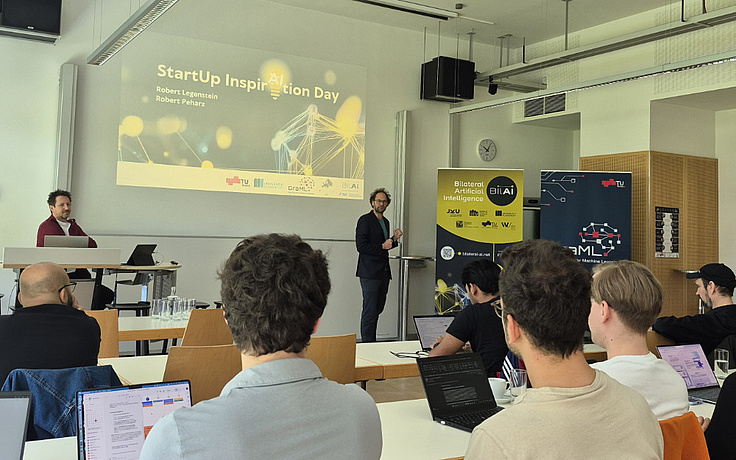
Bilateral AI had the pleasure of co-hosting the StartUp InspirAItion Day at TU Graz - a morning dedicated to entrepreneurship, artificial intelligence and the many different paths that lead from an idea to a startup.
Rather than focusing on polished success stories alone, the invited speakers shared their diverse, authentic and sometimes very personal founding stories, which rarely followed a straight line. Their journeys were shaped by unexpected moments, competing priorities, changing interests, and conversations with others.
Entrepreneurship starts in unexpected places
One of the recurring themes throughout the morning was that startup ideas do not always arrive in carefully planned moments and they also need time to evolve.
Ralph Stöckl, co-founder of SimplyAI FlexCo, shared how he founded his startup together together with his brother after something as unexpected as a failed water skiing booking — a reminder that succesful entrepreneurial opportunities can emerge from everyday experiences..
Also focusing on the initial phases of the entrepreneurial path, Samuel Ziegler gave very honest insights into adjusting and finetuning your idea in the very beginning of his founder journey. While completing his Master’s thesis, he is preparing the official launch of vetosec, demonstrating that building a company often means balancing multiple priorities simultaneously rather than waiting for ideal conditions.
Challenging the myths around founding
Another highlight came from Lucija Veličan Marković, PhD, who used the founding story of Ruth to challenge common assumptions around entrepreneurship.
One message stood out in particular: there is rarely a perfect moment to start.
Questions around timing, readiness, and certainty are familiar to nearly every aspiring founder — but waiting for ideal conditions may mean waiting forever. Entrepreneurship is often less about perfect timing and more about taking deliberate action with the resources and knowledge available today.
Following curiosity across disciplines
The interdisciplinary nature of entrepreneurship became especially visible through the perspective of Dr. Michael Reip and his startup openmaind.
Starting from a strong enthusiasm for robotics, his journey increasingly expanded into economics and business considerations — illustrating how startup building frequently requires founders to move beyond their original expertise and embrace new perspectives.
The takeaway: founders do not need to know everything from day one. Resources, networks, and support systems exist to help ideas grow.
Conversations that move ideas forward
Throughout the event, Mario Fallast and Harald Jenull guided the discussion with practical entrepreneurial experience and candid reflections.
Their message was encouraging and pragmatic: entrepreneurship does not mean taking reckless risks alone. Guidance, support, and structured approaches can make the journey significantly more manageable.
Afterwards, participants had the opportunity to exchange ideas with speakers, hosts, fellow attendees, and representatives from the Technology and Transfer Offices of Graz University of Technology and University of Klagenfurt as well as Science Park Graz (SPG) and build! Gründungszentrum Kärnten. A great opportunity to directly turn inspiration into conversation and conversation into potential next steps.
Across stories, backgrounds, and startup stages, one recommendation repeatedly surfaced:
Talk to people about your idea. Conversations create feedback, reveal opportunities, challenge assumptions, and often become the starting point for collaborations that would not happen otherwise.
A sincere thank you to everyone who contributed to making StartUp InspirAItion Day possible.
Special thanks to Graz Research Center for Machine Learning (GraML), the ELLIS Unit Graz, and the technology transfer offices of TU Graz and Universität Klagenfurt for joining forces to create an inspiring and open environment for entrepreneurial exchange.
We are grateful to all speakers for their authentic stories, participants for their curiosity and questions, and partners for our collaboration and we look forward to continuing the conversation.